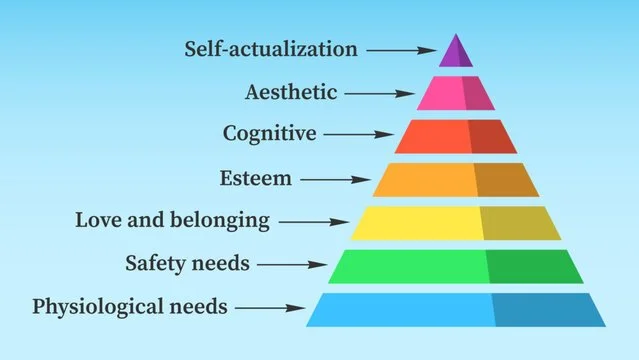
The Pyramid of Needs
Motivation. Where does it come from? Having an understanding of what drives our motivation can help get us going in a certain direction or at least get us to place our focus somewhere again. Being out of tune with what you need can lead you nowhere. Here, we explore Maslow's Theory of Motivation. Maslow’s Theory of Motivation emphasizes that everyone has physiological and psychological needs that can range anywhere from very basic to much more complex. These needs, Maslow argued, are what drive our motivation as well as being linked to personality. Visualize a pyramid, with different needs on each elevator. Within this hierarchy, everyone is motivated at either basic levels or more advanced levels, to attempt to get their needs met. Where do you see yourself on this elevator?
What makes people happy? What steps do people take to become happier human beings? According to Maslow, most human beings have a need to feel self-actualized. That is, to feel that they have reached their full potential at least as much as possible. This approach was considered a humanistic approach and more optimistic. Think of this hierarchy of needs as a more positive path to wellness and mental health rather than an over analysis of the negative behaviors and problems that stem from them. The path to becoming self-actualized follows the path of the need for food, a basic need, safety, love and self-esteem. These needs are instinctual and a strong motivational force.
Physiological Needs:
At the bottom of the pyramid are physiological needs, such as a need for water, food, and the ability to breathe. Physiological needs also include a need for shelter and the ability to clothe oneself. Sexual reproduction is also included as a physiological need.
Safety Needs:
At the next level we see a strong need for feelings of safety and security. This includes financial security, a need for health and wellness, prevention and safety against accidents or injuries. Being able to maintain employment, having a savings plan, moving to a safer neighborhood are several examples. These two needs are considered basic needs in the pyramid.
Love and Belonging:
Needs such as love, acceptance and belonging are considered social needs. The need to form friendships, the need for romantic attachments, the need for family affiliation, the need to form social groups or belong to a church or non-religious organization. The need for belonging and acceptance prevents us from experiencing feelings of loneliness, depression, and anxiety. Involvement in team sports, knitting clubs, book clubs, discussion clubs, all help create a feeling of belonging.
Self-Esteem Needs:
At this level, there is a need to feel appreciated and respected. There is a strong need at this level of the pyramid to make efforts to meet these needs for self-esteem and self-worth. It is a very strong motivational force. There is a strong need to feel valued by others and to somehow contribute meaningfully to the world. There is a high need for professional affiliation, academic achievements, and developing personal hobbies. These can all enhance esteem needs.
Self-Actualization:
At the top of the pyramid, sits self-actualization. Here personal growth is of the essence, self-awareness, less concern for the opinions of others. Fulfilling one’s potential is an important focus in self-actualization. It is the full use of all capabilities, talents, hobbies, interests. There is a high level of fulfillment at this level of the pyramid.
The progression through this pyramid from the bottom to the top elevator starts at a basic level of needs and becomes more social and psychologically complex at the higher levels the pyramid. At the top, personal esteem and accomplishment are essential to overal happiness and satisfaction.
According to Maslow there are two main types of needs, deficiency needs and growth needs. Deficiency needs arise from deprivation whereas growth needs arise from a desire to learn and grow as a person.
Some criticisms of the pyramid of needs are that needs don’t follow a hierarchy in such a rigid manner. Also, the theory is difficult to test, and some have argued that Maslow's tests were biased as he knew the participants in the research study. Some believe that Maslow’s pyramid of needs was inspired by the beliefs of the Blackfoot Nation, which he studied in his days as an anthropologist.
This humanistic approach was refreshing for psychology as its focus was on developing healthy individuals and enhancing wellness.
3 additional needs were later added:
Cognitive, Aesthetic and Transcendence.
Cognitive needs focus on knowledge. Aesthetic needs includes a strong appreciation for beauty. The need for transcendence focuses on spirituality and connecting with nature.
This pyramid can be useful to tune in to what your needs are and enhance overall health and wellbeing. It is meant to be used as a helpful guide and is not a replacement for therapy. If you’re feeling stuck or need more guidance, please don’t hesitate to visit saraperrettatherapy.com to learn more and book your consultation today.